

Weight Loss with Diet and Exercise: A Practical Guide
You finish work, realise you've spent most of the day sitting, and decide dinner is where the correction starts. You cut portions, skip a snack, and promise yourself you'll exercise tomorrow. A few days later, the scale hasn't changed much, hunger is louder, and the plan feels like another task competing with work and family.
That experience doesn't mean you lack willpower. Weight loss with diet and exercise works better when you treat it as an energy-balance project, not a test of character. Food creates the main lever for reducing energy intake, while movement increases expenditure, supports fitness, and helps you keep active tissue as your body weight changes. The practical challenge is building a moderate deficit you can repeat.
Ireland's survey data gives that challenge useful context. In 2022, 41% of adults reported a normal weight, 35% reported being overweight and 21% reported obesity, meaning 56% were above a healthy weight category. Among people trying to lose weight, 71% said they were taking more exercise or doing more manual labour, while 53% reported eating fewer calories and 46% said they were eating or drinking less of certain items. The pattern is clear: sustainable efforts already tend to combine food changes with movement, rather than relying on either one alone. (Healthy Ireland Survey 2022)
Why Diet and Exercise Have to Work as a Team
A desk-bound professional may reduce breakfast, choose a smaller lunch, and stop buying office biscuits, yet spend the rest of the day sitting through meetings and commuting before recovering on the sofa. After the early fluctuation settles, the scale barely moves.
The issue is not that eating less has no effect. A calorie deficit is required for weight loss, while diet and movement influence different parts of the same system. Food controls the energy entering the body. Exercise and everyday activity affect energy leaving it, and resistance training gives the body a reason to retain muscle as weight decreases.
A diet-only plan can become difficult when portions keep shrinking. Hunger may rise, spontaneous movement may fall, and lean tissue can be lost alongside fat. Exercise-only plans face a different limit: one demanding workout may not offset frequent high-energy meals, snacks, or drinks.
Practical rule: Use food to create the deficit, and use movement to make that deficit easier to maintain.
Combining both approaches also gives you more useful progress signals. Track portions, walking, training sessions, energy, strength, and consistency instead of handing all the judgment to one morning's scale reading. A shorter walk repeated daily can matter: ten minutes after breakfast, another ten at lunch, and a final ten after dinner create thirty minutes of activity without requiring one long workout. Repeated low-intensity movement can shift the daily energy balance through accumulation.
Ireland's national physical-activity data shows why this lever deserves attention. 41% of adults met the national guideline of at least 150 minutes of moderate activity per week in 2024, down from 46% in 2019. Regular movement remains a public-health challenge, so a plan should make activity fit ordinary routines rather than depend on motivation alone.
For a practical, non-punitive approach to food, habits, and daily routines, Healtsy wellness advice offers a useful companion resource. The central lesson is straightforward: avoid chasing the smallest possible food intake or the hardest possible workout. Build two manageable levers that support each other.
The Calorie Deficit Explained Without the Maths Headache
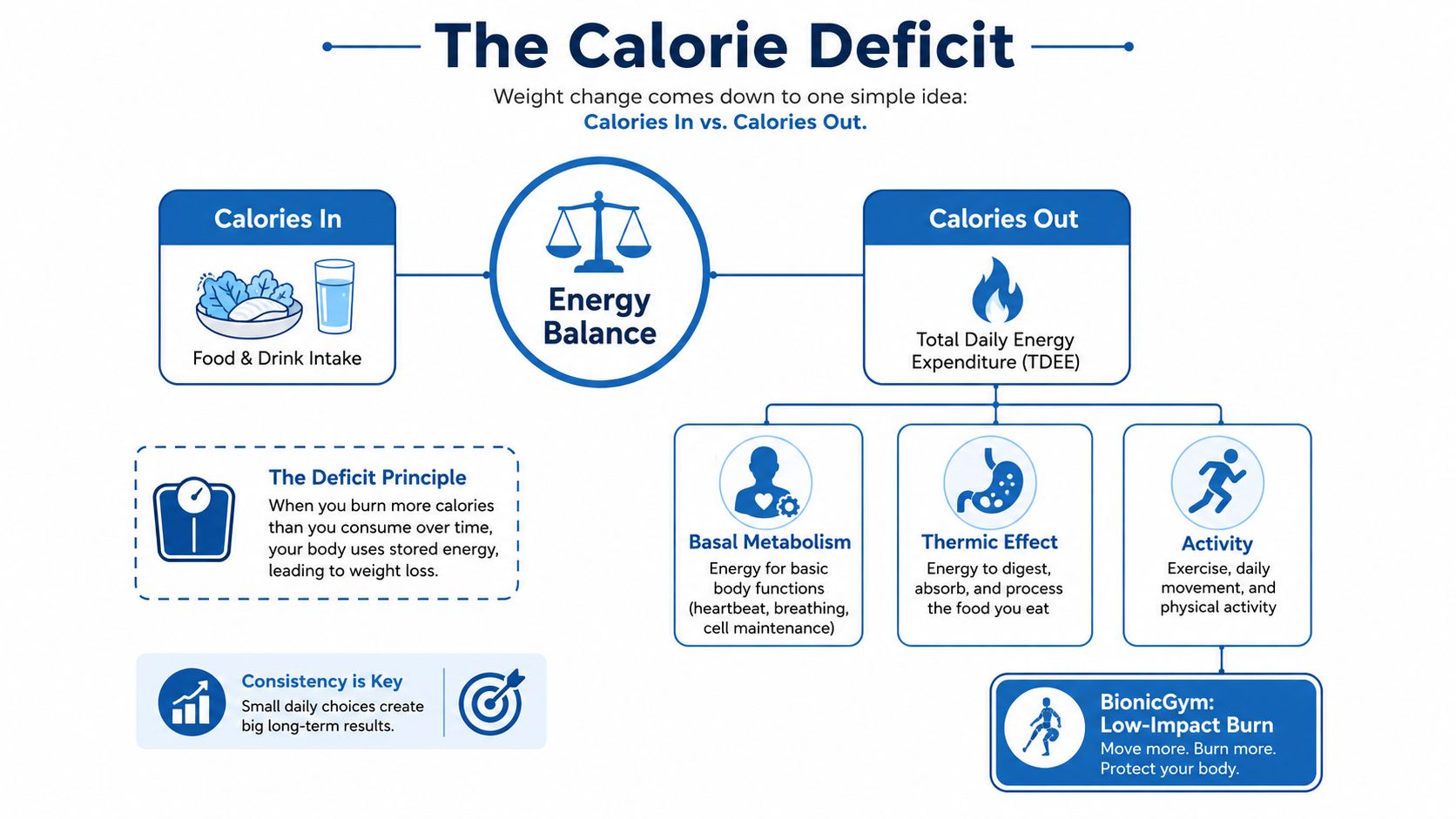
Think of your daily energy balance as a bank account. Food and drink are deposits. Your body's basic functions, digestion, exercise, and ordinary movement are withdrawals. If withdrawals consistently exceed deposits, the body draws on stored energy. If deposits consistently exceed withdrawals, stored energy tends to rise.
The withdrawal side is called Total Daily Energy Expenditure, or TDEE. It includes several parts:
- Basal metabolism: Energy used for essential functions such as breathing, circulation, and maintaining the body.
- Thermic effect of food: Energy used to digest and process what you eat.
- Activity: Structured exercise plus daily movement, including walking, standing, chores, and other non-gym activity.
A moderate target beats a dramatic cut
Irish weight-management guidance presents around 500 kcal per day fewer calories, combined with increased physical activity, as a realistic starting point for losing about 0.5 to 1 kg per week. It also commonly frames 5% to 10% body-weight reduction as a clinical goal. (National Dairy Council weight-loss guidance)
A worked example makes the idea less abstract. Suppose an adult's estimated daily expenditure is 2,300 kcal. Eating about 1,800 kcal would create an approximate 500 kcal daily gap. Repeated across seven days, that is an approximate weekly shortfall of 3,500 kcal, which aligns with the Irish guidance's broad expectation of about 0.5 to 1 kg weekly loss. It's an estimate, not a promise, because appetite, water retention, body composition, activity, and adherence all affect the scale.
You don't need to create the entire deficit through food. A smaller reduction in intake paired with walking, cycling, resistance training, or another activity can feel more manageable. Exercise also helps support muscle retention, and Irish guidance notes that muscle burns calories, making training useful beyond the calories recorded during a session.
The common mistake is assuming a larger deficit must produce better results. Severe restriction can increase hunger, reduce spontaneous movement, impair training, and make the plan collapse. A sustainable deficit is more like a steady standing order than an emergency bank transfer. For a further explanation of this model, see BionicGym's guide to the calorie deficit for weight loss.
What to Eat So You Actually Lose Fat, Not Just Weight
The scale measures total body mass, not fat alone. During weight loss, the aim is to reduce stored fat while giving the body enough nutrition and training stimulus to retain as much lean tissue as practical. That starts with a food pattern that creates a deficit without making every meal feel like a punishment.
Protein has two important jobs. It supports tissue maintenance and tends to make meals more filling, which can help you stay within your calorie target. Include a clear protein source at meals, such as eggs, fish, poultry, yoghurt, beans, lentils, or tofu.
Carbohydrates provide useful fuel for walking, cycling, strength work, and ordinary concentration. Cutting them aggressively can leave some people flat during training and more likely to abandon the plan. Choose portions that fit your energy needs, with options such as potatoes, oats, rice, wholegrain bread, fruit, and beans.
Fats support normal body functions and help the body absorb fat-soluble vitamins. They're energy-dense, so portion awareness matters, but removing them entirely isn't necessary. Olive oil, nuts, seeds, avocado, and oily fish can fit into a balanced pattern.
Use a plate you can repeat
A simple hand-based structure avoids the false precision of rigid macro percentages:
- Protein: A palm-sized portion at a meal.
- Vegetables: A fist-sized portion or more, adjusted to appetite.
- Carbohydrates: A cupped-hand portion, particularly around active periods.
- Fats: A thumb-sized portion from a nourishing source.
This isn't a prescription for every person or meal. It's a visual starting point that helps you adjust portions without weighing every ingredient. The best framework is the one you can follow across ordinary Irish routines, including work lunches, family dinners, weekends, and meals eaten away from home.
Common pitfalls include eating too little protein, treating carbohydrates as automatically fattening, and depending on highly processed “diet” products that leave you unsatisfied. Nutrient-dense food helps because it gives you more volume, fibre, protein, and micronutrients for the calories you eat. For quick meal ideas built around protein, explore these high-protein dinners, then adapt portions to your own deficit. BionicGym's discussion of sustainable weight loss through diet plus exercise reinforces the same principle: food quality and movement work best as a combined routine.
Choosing the Right Exercise for Your Deficit
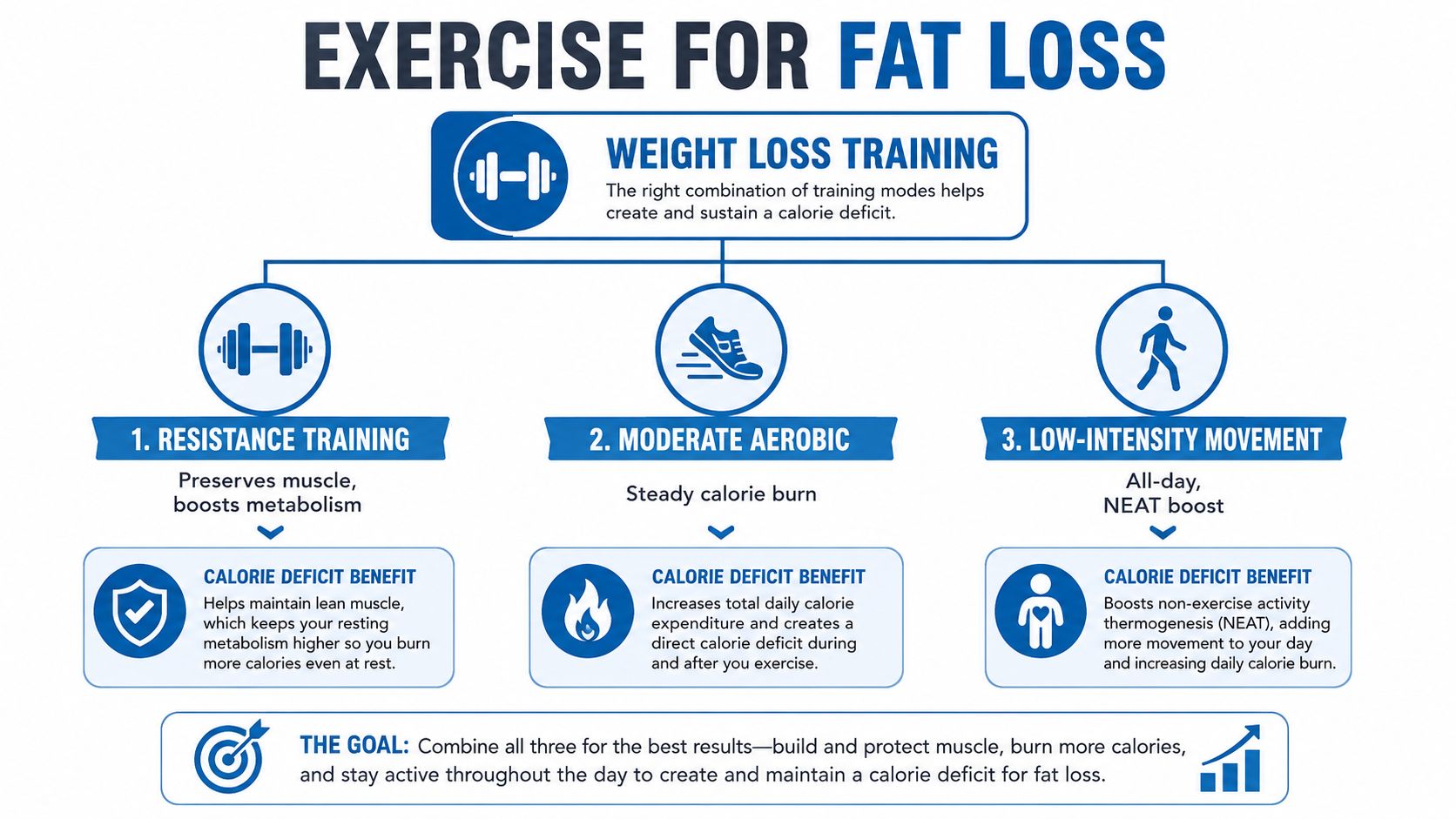
Exercise supports fat loss in three different ways. Resistance training helps preserve lean mass while food intake is lower. Moderate aerobic activity adds repeatable weekly movement. Vigorous work uses more energy per minute and challenges aerobic fitness, but it also requires more recovery.
Start with the muscles you want to keep using. Chair squats, hip hinges, presses, rows, carries, and controlled body-weight exercises can make up a short session. The goal is a consistent signal to your muscles, not exhaustion after every workout. This protects your deficit from becoming a period of losing both fat and useful muscle.
Brisk walking, cycling, swimming, and similar activities count as moderate aerobic work. Breathing and heart rate should rise, while conversation remains possible. Ireland's HSE recommends 2 hours and 30 minutes of moderate-intensity aerobic activity each week for weight management, along with muscle-strengthening exercise on at least 2 days weekly in its obesity treatment guidance.
Match intensity to the job
The weekly target depends on the type of activity. Ireland's national guidelines advise adults aged 18 to 64 to accumulate 2 hours 30 minutes to 5 hours of moderate aerobic activity, or 1 hour 15 minutes to 2 hours 30 minutes of vigorous activity, alongside strengthening work on 2 or more days. Older adults and adults living with a disability are advised to include multicomponent strength-and-balance activity on 3 or more days weekly to support function and reduce falls risk. These recommendations appear in Ireland's national physical-activity guidelines.
For weight loss, Irish patient-facing guidance often points beyond the basic health minimum, towards 60 to 75 minutes of moderate activity on at least 5 days per week, combined with dietary change. A desk-bound adult can divide that total into shorter bouts. Healthy Ireland guidance notes that activity bouts can count at at least 10 minutes, while its advice also describes 30 minutes on 5 days as 150 minutes weekly and 60 minutes on 5 days as a route to additional health benefits. See the Healthy Ireland activity guidance for the wider context.
Choose the intensity that matches your recovery, schedule, and deficit. BionicGym is an FDA-cleared wearable electrical-stimulation exercise device that can provide vigorous cardio without loading or flexing the joints. The effort should still be judged by observable signs, such as a raised heart rate, breathlessness, and sweat at higher intensities. For a comparison of exercise choices, read this guide to the best exercise for weight loss.
The Cumulative Calorie Burn Desk Workers Often Miss
A 45-minute workout is easy to notice. For a desk-based adult, four hours of low-intensity movement spread across the workday may seem insignificant, yet the combined total can meaningfully change energy balance. Walking during calls, doing household chores, standing more often, and using a seated exercise system can add activity without requiring one long gym session.
The example below uses the planning figure for this approach. If a desk-bound adult adds 4 hours of low-intensity work at roughly 250 kcal per hour, the added expenditure would be about 1,000 kcal for that day. Pairing that activity with a modest dietary deficit creates a much larger daily shortfall. It remains an example, not a guarantee, because actual burn varies with the person, intensity, device settings, and duration.

The lesson is not to force four-hour sessions. Duration can compensate for lower intensity when movement fits around work, television, email, or chores. BionicGym was invented and developed by a medical doctor. Its wearable leg wraps use electrical impulses to stimulate the leg muscles. Build intensity gradually, and judge the session by your physical response rather than by a headline claim.
A longer session may leave you warm, sweaty, or breathless at higher settings, while a gentle session may feel easier and last longer. Use the BionicGym Weight Loss Calculator to model your own scenario instead of copying someone else's estimate. The calculator helps set expectations. BionicGym cannot guarantee weight loss, because food intake still affects the energy balance.
For a closer explanation of how shorter activity periods add up, read about cumulative calorie burn for weight loss.
A demonstration can help distinguish active muscle stimulation from passive gadget marketing. Safe examples include seated work, watching television, emailing, browsing, or household chores. Do not use an exercise device while driving, handling dangerous objects, climbing steps, crossing roads, cycling outdoors, skateboarding, or skiing.
Common Mistakes That Quietly Stall Progress
A person can follow a tough workout, feel they earned a large meal, and still finish the day above maintenance. That is the first mistake: trying to out-train a poor diet. Exercise raises energy expenditure, but extra snacks or oversized portions can cancel the planned deficit before they are noticed. Food and movement must support the same daily target.
The second mistake is cutting intake so sharply that the plan cannot survive an ordinary stressful week. A dramatic reduction may produce a quick scale change, yet hunger, low energy, and weaker training can make adherence collapse. A moderate shortfall tracked over time usually gives you more useful information than an aggressive target followed briefly.
The third mistake is treating recovery as optional. Poor sleep, work pressure, and a crowded schedule can affect food choices and reduce spontaneous movement, even when the calorie plan is sound. Prepare a fallback meal and a shorter activity option for difficult days. These are practical safeguards, not tests of willpower.
Avoid the scale traps
Spot reduction is not controllable. Strengthening a particular muscle can improve its function and appearance, but it cannot dictate where stored fat is lost first. A lower scale reading can also hide a poorer result if the process reduces strength, energy, or consistency. Measure progress with body weight, performance, and how reliably you can follow the plan.
People using GLP-1 medicines may have extra reasons to protect lean mass with adequate protein and resistance exercise. Anybody with a serious medical condition or injury should consult with their medical practitioner before starting any new exercise program. BionicGym is a great way to exercise. It is not a medical treatment. Consult your doctor if you have a serious condition.
Read the BionicGym guide to why dieting alone fails for a clearer explanation of why food-only thinking can fall short. Then use the Weight Loss Calculator to test your assumptions. It cannot predict your exact outcome, but it can show whether your planned intake and activity match the result you expect.
Building a Weekly Plan You Will Actually Stick To
A workable week starts with realistic appointments, repeatable meals, and room for disruption. Treat the plan like a budget: assign effort where it has the greatest effect, then leave enough margin for busy days.
| Weekly element | Practical starting point |
|---|---|
| Resistance work | Two short, focused sessions |
| Moderate aerobic activity | Three to five bouts, such as brisk walks or cycling |
| Background movement | Regular low-intensity activity while seated or doing chores |
| Food structure | Protein at meals, vegetables, sensible carbohydrate portions, and minimally processed staples |
Ireland's physical-activity guidance recommends 2 hours 30 minutes of moderate activity weekly, with strengthening on 2 or more days. Use that as a starting framework, not a test to pass. Add time only after the current routine feels stable.
Choose one keystone habit first. Log weekday dinners for two weeks, or schedule two resistance sessions before adding another target. A small habit repeated across several days can shift the weekly energy balance more reliably than an ambitious plan abandoned after one difficult day.
Low-intensity movement can fill the gaps. A few minutes of activity while seated or completing chores may seem minor, but repeated often, those minutes become a useful contribution to your daily deficit. Wearable data, simple food logging, and the BionicGym companion app can reduce the mental effort of tracking sessions and intensity.
For seated or chore-based activity, compare the BionicGym Standard with the BionicGym PRO+HIIT. Choose according to the session type, your tolerance, and how gradually you plan to progress.
Putting It All Together for the Long Run
Sustainable weight loss works like a household budget: food intake and activity must create a manageable calorie deficit over time. Build meals around protein and minimally processed foods, include resistance and aerobic exercise, and use low-intensity movement to add small contributions throughout the day.
Judge progress across weeks rather than by a single scale reading. Start by using the Weight Loss Calculator to model a realistic trajectory, then choose one movement habit you can repeat. Consistency matters more than perfection because repeated choices gradually change energy balance.
BionicGym provides app-guided, wearable electrical-stimulation exercise while seated or completing safe household tasks. Visit BionicGym to assess whether it fits your diet-and-exercise plan.